
How We Built Doctor On Demand's Telemedicine Platform
The challenges behind a mobile-first telemedicine platform: secure video, cross-device parity, scheduling, payments and EHR integration.

Doctor On Demand connects patients with board-certified physicians, licensed psychologists and psychiatrists through secure video, around the clock, on any device. Its care covers urgent care, mental health, preventive care, and chronic condition management. Supporting that range of care means treating mobile access, browser access, clinical workflows, and reliability as parts of one service rather than unrelated features.
Our Doctor On Demand case study describes work across native iOS and Android applications, a responsive web platform, video consultations, scheduling, payments, and healthcare integrations. This article expands the engineering questions behind that work while keeping the boundary between documented project facts and general guidance explicit. Project-specific statements come from that case study; detailed implementation patterns below explain how telemedicine teams generally address comparable problems, not undisclosed details of this platform.
Key takeaways
- Doctor On Demand needed a mobile-first telemedicine platform with secure video care on iOS, Android and web.
- Feature parity across devices let patients move between phone, tablet and computer.
- Scheduling across time zones, payments and EHR integration were core to the telemedicine platform.
- HIPAA-aware design decisions were made from discovery onward, not added at the end.
The challenge: growth without sacrificing trust
The documented challenge was to support rising patient demand without sacrificing trust, security, or clinical quality. The case study identifies a secure, reliable, mobile-first application and a web companion with full feature parity. It also describes requirements for high-quality video aligned with HIPAA privacy standards, real-time scheduling and payments, and electronic health record integration.
Scale was part of the challenge, including thousands of concurrent appointments across time zones. That is an architectural requirement in the case study, not a newly measured benchmark presented here. The product also needed to support mental health, urgent care, and chronic condition management within one application, rather than solving only a single visit type.
Those requirements are closely connected. Scheduling determines who can enter a consultation and when. Identity and permissions determine who can see information about that consultation. Integration determines how clinical information reaches the appropriate workflow. Reliability determines whether the patient and provider can complete the encounter when it matters.
For other teams, the central lesson is to define the service boundary before choosing isolated components. A video SDK, a calendar widget, and a patient profile screen do not become a coherent clinical service simply because they are available in one application.
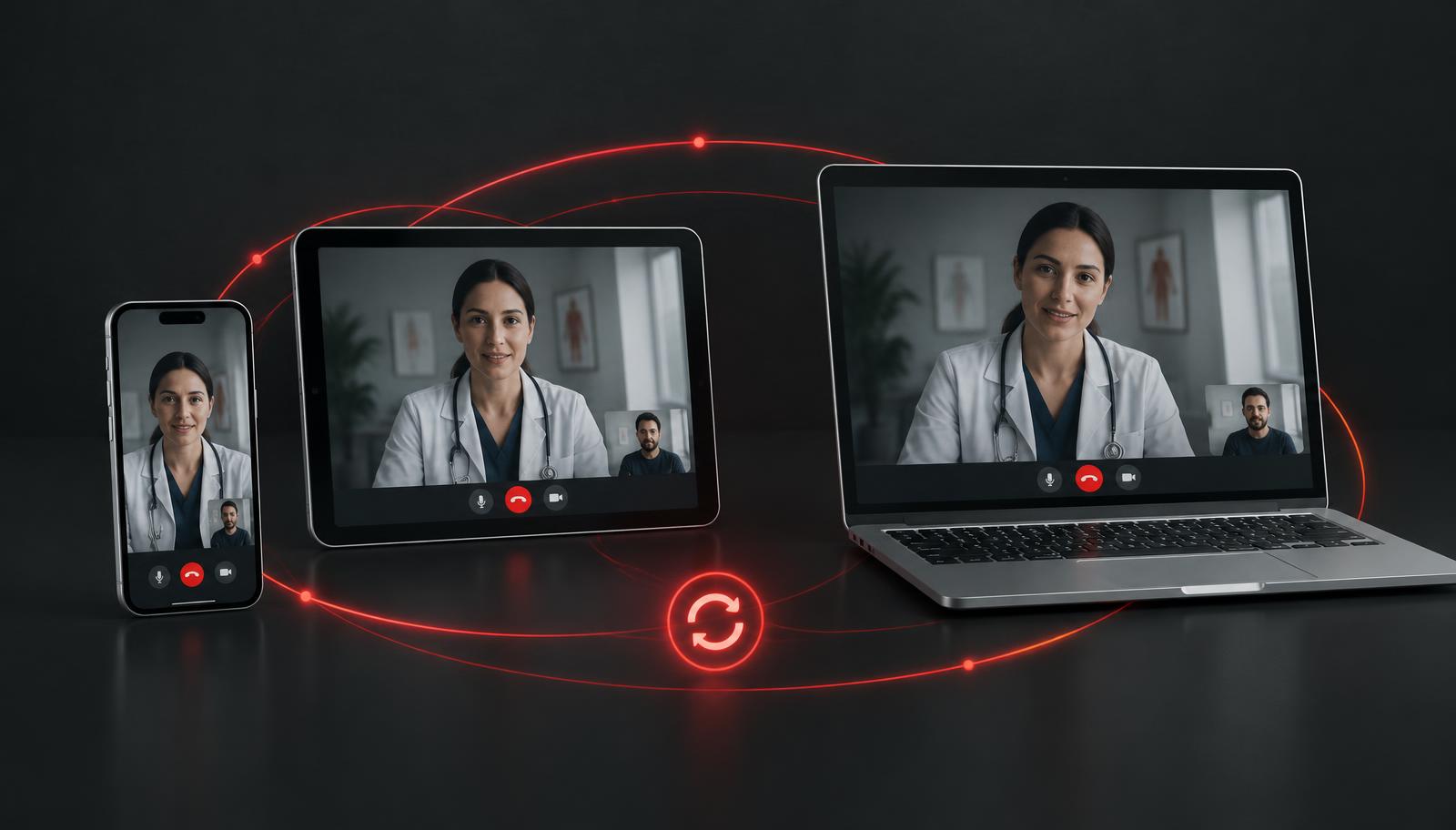
What the case study documents about our approach
The documented approach includes discovery and compliance strategy, native mobile development, responsive web development, healthcare systems integration, scalable cloud architecture, and continuous collaboration. The collaboration involved product managers, clinical workflow specialists, and engineering teams across mobile and web.
Native iOS and Android work focused on onboarding, reliable video calls, and intuitive navigation. The responsive browser platform was intended to match the mobile experience feature for feature. Integration work covered EHR systems, payment gateways, insurance verification, and prescription workflows. The cloud architecture addressed high-volume simultaneous video sessions.
The case study lists WebRTC, HIPAA, Node, iOS, and Android in its stack. HIPAA in that list describes a regulatory context, not a programming framework. The entry does not identify a particular cloud vendor, media provider, database, EHR vendor, integration protocol, or deployment topology. It also does not specify the mobile programming languages. Those details should not be inferred from the broader technology categories.
This distinction matters when reading an engineering case study. A documented capability establishes what the product supports; it does not automatically establish every technical mechanism underneath it. The sections that follow use the documented work as context and clearly frame more detailed patterns as general telemedicine engineering guidance.
Discovery and compliance strategy
The case study describes compliance-aligned design and development aimed at adherence to HIPAA and other healthcare standards. It also describes close collaboration with clinical workflow specialists. Together, those facts establish that healthcare requirements were part of the approach rather than an unrelated checklist added to the interface.
In a comparable telemedicine project, discovery should map the patient journey and the provider journey separately, then identify the points at which they interact. Registration, appointment selection, intake, consultation entry, follow-up, and record updates each have different data and permission needs. Support staff may need a third set of workflows with much narrower clinical visibility.
A useful general discovery artifact is a data-flow map. It identifies what information enters the service, why it is needed, where it travels, who can access it, and what happens when the workflow ends. That map supports architecture, vendor review, privacy decisions, and testing without assuming that every team member needs access to every category of information.
Teams should also identify who can approve clinical wording, security controls, retention policies, and operational procedures. Engineering can implement a decision, but it should not silently become the owner of medical policy or legal interpretation. Defining those responsibilities early reduces ambiguous acceptance criteria and late redesign.
For broader planning, see our healthcare software development services and HIPAA-compliant app development checklist. These are general resources, not evidence that a particular undisclosed control was used in this project.
Native mobile experiences for patients seeking care
The documented mobile work covered native iOS and Android experiences with smooth onboarding, reliable video, and intuitive navigation. The case study also identifies mobile-first usability as a challenge. These priorities make sense together: patients need to reach care, not learn the internal structure of a healthcare organization.
For telemedicine products generally, the most important interface work often happens around the consultation rather than inside the video frame. Users need to understand whether an appointment is confirmed, what preparation is required, whether permissions are missing, and what to do if the connection fails. Unclear state can feel like a service failure even when the underlying systems are functioning.
A practical design approach is to make the next action explicit and limit competing decisions during a time-sensitive journey. Explain camera and microphone access in context. Use understandable validation messages. Preserve completed work where appropriate so an interruption does not force a patient to repeat the entire process.
Native applications must also account for platform behavior. Calls, notifications, permission changes, background transitions, and audio routing can affect a video visit. These are general mobile engineering concerns; the case study does not describe individual platform APIs or specific recovery mechanisms used by Doctor On Demand.
For teams deciding how to build their own mobile experience, our mobile app development services provide a starting point for discussing platform requirements and integration constraints.
Cross-device parity without assuming identical implementation
The case study describes a responsive browser-based platform matching the mobile experience feature for feature. It also describes a “single codebase mindset” across native mobile and web as a takeaway. That wording should not be read as proof that the applications shared one literal source codebase or used a cross-platform mobile framework.
Feature parity is best understood as a product commitment. A supported user should be able to complete the required journey on each supported platform. Different implementations may still be appropriate because browser permissions, screen sizes, operating system behavior, and accessibility tooling differ.
In general, teams can manage parity with a shared capability matrix. For each journey, record expected behavior on iOS, Android, and supported browsers. Include authorization, error states, data visibility, and completion criteria rather than marking a feature complete merely because its initial screen exists.
Shared backend contracts can help keep business rules consistent. Design systems and common terminology also reduce accidental differences. However, a responsive web layout still needs independent testing, especially for media permissions and device selection. Reusing requirements is valuable even when implementation code cannot be reused.
Parity also does not automatically establish session handoff. The source entry does not describe whether a patient can move an active consultation between devices. A team considering that feature should treat it as a separate requirement involving identity, session ownership, media state, and privacy rather than assuming it follows from browser availability.
Video consultations and the role of WebRTC
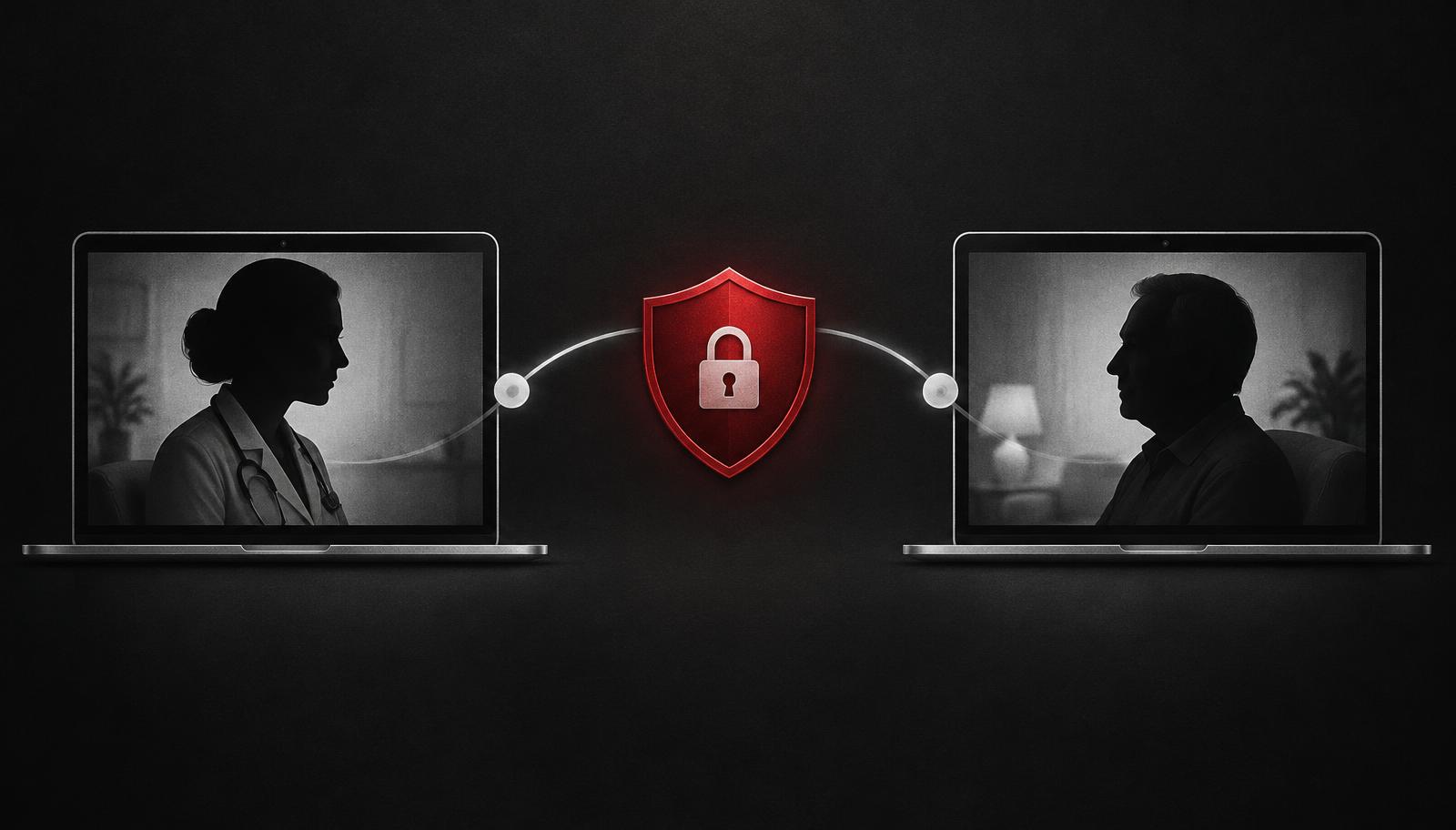
WebRTC appears in the documented stack, and the case study describes encrypted video communication protecting patient confidentiality. It also identifies reliable video consultations as a central product requirement. Those are the supported facts; the source does not disclose the signaling service, media routing model, relay configuration, or communication vendor.
In general, WebRTC provides building blocks for real-time audio and video, including media transport and connection negotiation. A complete telemedicine application still needs surrounding systems to establish who may join, locate the correct session, exchange connection information, and represent the consultation lifecycle.
A useful way to think about video architecture is to separate the media path from the appointment workflow. The media path carries audio and video. The appointment workflow determines whether a session should exist, which participants belong in it, and what happens before and after it. Both need reliability, but they fail in different ways.
Connection setup and media permissions
For comparable platforms, pre-visit checks can help users identify missing camera or microphone permissions before the consultation begins. Device selection needs understandable controls, and errors should distinguish unavailable hardware from denied permissions when the platform allows that distinction.
Connectivity can require relay infrastructure when direct communication is not possible. The appropriate architecture depends on the session model and environment. This is a general WebRTC consideration, not a claim about the precise network design used in this project.
Teams should also define a safe entry process. An authenticated user should not gain access to an unrelated consultation by changing a client-side identifier. Authorization belongs in trusted server-side workflows, with client controls supporting usability rather than acting as the only barrier.
Interrupted sessions and degraded networks
General video testing should include network changes, temporary disconnection, app backgrounding, and audio device changes. The interface should distinguish “connecting,” “connected,” and “trying to reconnect” without promising a recovery that has not occurred. Clinical teams should help define operational fallbacks where technology cannot restore the session.
Media telemetry can support diagnosis, but teams should avoid collecting sensitive information merely because it is technically available. Recordings, transcripts, and diagnostic payloads have different privacy implications and require explicit decisions. Nothing in the case study establishes that recording or transcription was part of the Doctor On Demand implementation.
Scheduling across time zones
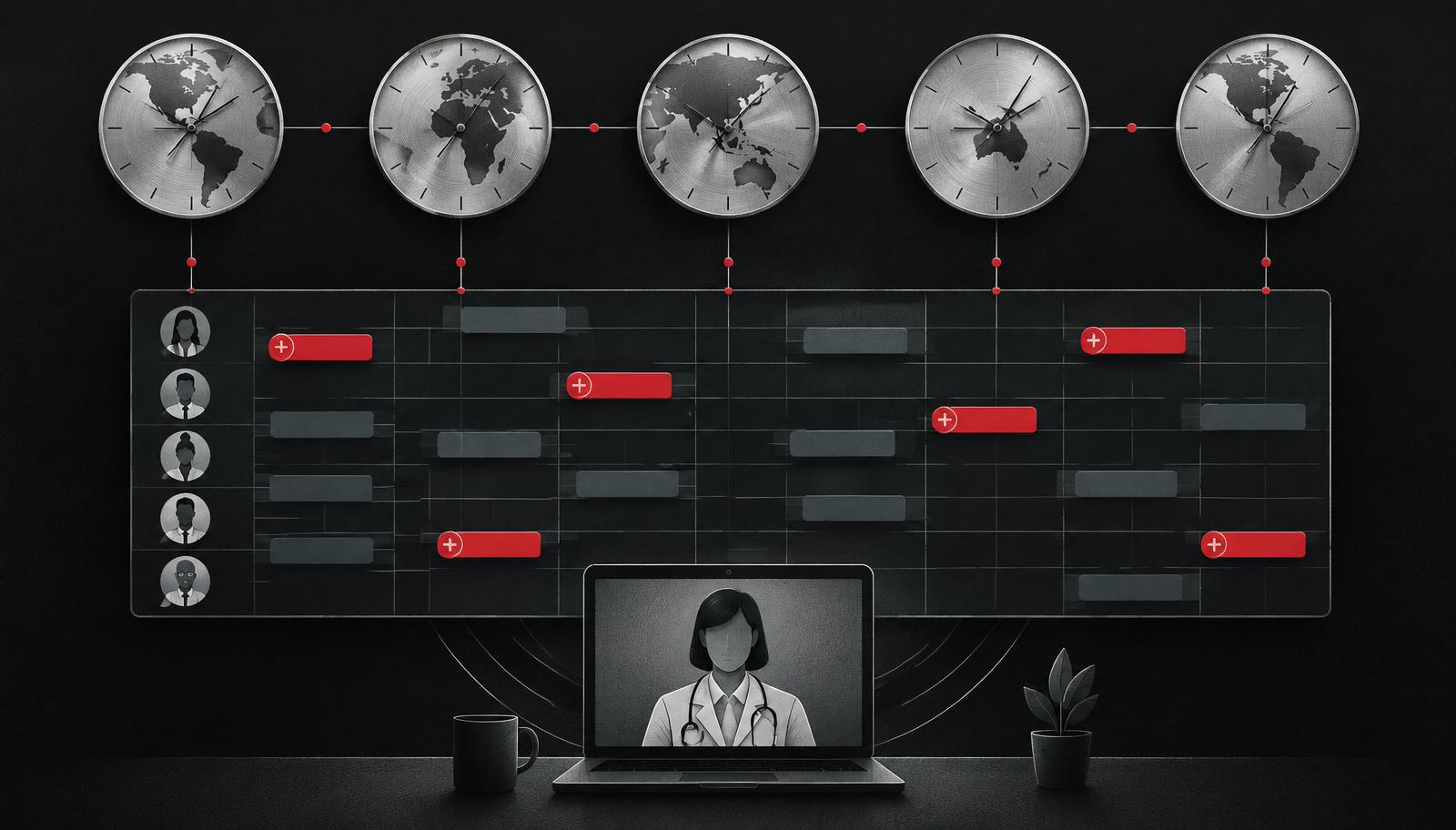
The documented challenge includes real-time scheduling and concurrent appointments across time zones. The case study also lists real-time booking among the delivered features. It does not identify the scheduling algorithm, calendar vendor, or specific representation of time.
For telemedicine teams generally, scheduling should distinguish an appointment's actual instant from the local time displayed to each participant. Time zone identifiers matter because daylight saving rules and regional changes cannot be represented reliably by a fixed offset alone. Users should see the relevant local time and enough context to avoid ambiguity.
Recurring availability adds another concern. A clinician's weekly availability may be anchored to local working hours, while a booked appointment is an agreed event. Treating those as interchangeable can create errors around daylight saving transitions. The system needs explicit rules for which interpretation applies.
Preventing conflicting bookings
A common engineering pattern is to make the scheduling service authoritative for availability and confirmation. If two users select the same opening, the backend must resolve the conflict rather than relying on whichever screen loaded most recently. Temporary holds, expiration, and confirmation should have clearly defined behavior.
Cancellation and rescheduling also need consistent rules. Notifications can arrive late, and users may act from older screens. A robust workflow rechecks the current state before making a change and communicates the result without ambiguity. These are general implementation principles, not disclosed project internals.
Coordinating reminders and visit readiness
Reminders should align with current appointment state and user preferences. A canceled visit should not continue generating outdated instructions. Teams also need to decide what operational staff can see when a patient has not completed preparation or cannot join.
The clinical operation should define the meaning of late arrival, missed appointments, and provider unavailability. Engineering can then express those policies consistently across mobile, web, notifications, and administration tools. Without shared rules, different channels may give participants conflicting instructions.
Payments and insurance verification
The source entry documents integrated payment options, payment gateway integration, and insurance verification. It does not disclose payment providers, payer relationships, pricing policies, or financial results. Those omissions are important because a capability description is not a billing implementation specification.
In comparable systems, payment and appointment state should be coordinated without being treated as the same thing. A payment request can be pending while an appointment has a separate confirmation state. External callbacks can arrive after a user closes the app, and retrying a request should not create duplicate financial actions.
Insurance verification likewise needs an explicit representation of uncertainty. Verification may return incomplete information or require follow-up. Product and operations teams should decide what the interface may promise, what requires human review, and how status changes are communicated. Clinical access decisions and financial disclosures require appropriate stakeholder oversight.
Support workflows are part of this architecture. Authorized staff may need to investigate a mismatch between appointment and payment status without seeing unnecessary clinical details. A good general design gives each role enough context to resolve its task while preserving appropriate information boundaries.
EHR integration and prescription workflows
The case study documents secure EHR integration and states that providers can update medical records and manage prescriptions inside the platform. It also describes integration work involving prescription workflows. It does not identify an EHR vendor, a prescribing network, an interface version, or whether a particular interoperability standard was used.
For other teams, the first integration question should be about the clinical workflow rather than the protocol. What information must be available before a consultation? What needs to be recorded afterward? Which system owns each data element? Who handles corrections, duplicate identities, or an unavailable external service?
Those questions determine the integration contract. A successful technical request is not necessarily a successful clinical update. The receiving system may apply validation rules, require specific identifiers, or expose only part of the expected workflow through its API.
HL7 and FHIR as general integration options
Healthcare integrations may involve HL7 messaging, FHIR APIs, proprietary interfaces, or combinations of approaches. The relevant option depends on the external system and the workflow it supports. FHIR availability alone does not guarantee unrestricted access to every resource or operation a product team wants.
Our HL7 vs FHIR integration guide explains the broader comparison. It should not be interpreted as evidence that Doctor On Demand used either specific protocol in this engagement. The case entry supports EHR integration as a capability, not a particular interface implementation.
Identity, retries, and reconciliation
In general, patient matching deserves explicit design. A weak match can put information in the wrong record, while a duplicate identity can fragment care history. Teams need agreed identifiers, exception handling, and an escalation path for uncertain matches rather than relying on convenient display fields.
External services will also fail or respond slowly. Retry behavior should avoid duplicate updates, and unresolved failures should reach an authorized operational workflow. Reconciliation helps establish whether the local application and external system agree after an interruption. These patterns make integration dependable without assuming that every interaction succeeds immediately.
HIPAA-aware design across the service
The case study describes HIPAA-compliant video, encrypted communication, compliance-aligned development, and healthcare security standards. These are documented claims about the project. The entry does not provide an independent audit report, legal opinion, or inventory of every administrative and technical safeguard, so this article does not imply one.
For telemedicine products generally, HIPAA-aware engineering extends beyond encryption. Access control, identity lifecycle management, auditability, vendor relationships, operational procedures, and incident handling all matter. Whether specific obligations apply depends on the organizations, data, activities, and relationships involved; qualified legal and compliance professionals should guide those determinations.
Limit access to the task
A useful general principle is to grant access based on the work a person is authorized to perform. Scheduling staff, clinicians, support agents, and technical operators do not necessarily need the same information. Authorization should be enforced consistently through backend services rather than relying on hidden interface controls.
Administrative access deserves particular scrutiny because it can affect many users. Sensitive changes may need stronger review, clear records, or a more restricted workflow. The exact controls should follow the organization's risk assessment and operational needs.
Treat operational data as part of the privacy boundary
Logs, analytics, crash reports, notifications, and support tickets can expose information if teams collect them without considering context. General safeguards include minimizing sensitive payloads, controlling access, and defining retention. A reminder should not disclose unnecessary clinical detail on a device's lock screen.
Backups and test environments need similar attention. Moving production information into a development environment is not automatically safe because the purpose is debugging. Teams should define approved diagnostic practices and ensure vendors and internal systems fit the intended privacy model.
Reliability and scalable cloud architecture
The source describes cloud components tuned for high-volume simultaneous video sessions and reports high reliability across thousands of simultaneous consultations. It does not supply a reproducible load-test report, latency measurements, availability percentages, or infrastructure diagrams. Those results should not be converted into invented performance benchmarks.
For teams building comparable services, reliability planning should cover the entire visit journey. A working media session is not enough if authentication prevents entry or scheduling shows the wrong appointment state. Conversely, a healthy API dashboard does not prove that patients can hear their clinicians.
Separate reliability objectives by capability. Booking, consultation entry, media quality, clinical record updates, and payment reconciliation have different failure modes. Define operational signals that help identify where a problem occurs without collecting unnecessary patient information.
Capacity testing should model realistic patterns, including concentrated appointment start times and reconnection attempts. External dependencies belong in the model because a service can be limited by an integration even when its own infrastructure has spare capacity. Cloud scaling is useful, but it does not correct unsafe state transitions or an unreliable external workflow.
Collaboration and quality across mobile and web
The case study explicitly describes continuous collaboration with product managers, clinical workflow specialists, and engineering teams. This matters because technical correctness and workflow correctness are not identical. A feature can behave exactly as specified while still making the clinical operation harder to perform.
For other teams, shared acceptance criteria provide a practical bridge. Describe the actor, starting conditions, expected result, and failure behavior for each important journey. Review those criteria across product, clinical, design, security, and engineering roles where relevant.
Testing should include supported devices and browsers, permission changes, poor connectivity, scheduling boundaries, integration failures, and authorization checks. Accessibility also belongs in the core review because healthcare users have varied abilities and circumstances. These are recommended practices, not a claim that the source documents a particular test suite.
Release coordination needs similar clarity. A backend change may affect several client versions that remain in use. Compatibility policies, controlled rollout, monitoring, and support preparation help teams manage that reality. The project entry does not specify its release cadence or rollout tooling, so no particular process is attributed here.
Outcomes and the limits of attribution
The case study reports nationwide adoption, millions of patient visits, improved engagement and retention, high reliability, and trust among patients and providers. It also describes industry recognition as a top U.S. telemedicine solution. These are qualitative and aggregate statements from the published entry, not new measurements established by this article.
The entry does not provide a before-and-after engagement rate, a retention percentage, a project timeline, or a breakdown assigning platform-wide outcomes to individual contributors. It would therefore be misleading to invent such figures or to claim that a particular engineering decision caused a quantified business result.
What can be said is that the documented work addressed a broad telemedicine service: native mobile access, responsive browser access, secure video, scheduling, payments, and healthcare integration. The takeaway for readers is the breadth of coordination required, not a promise that copying one architecture will reproduce another organization's adoption.
Lessons for other telemedicine teams
Design for a patient's difficult day. Clear navigation, understandable status, and recoverable errors become especially important when users are ill, anxious, or unfamiliar with digital care. Simplicity is an engineering and operational concern as well as a visual design choice.
Treat video quality as a clinical feature. Connection setup, permission handling, network transitions, and fallback procedures deserve deliberate design and testing. A successful demonstration on a fast office network does not establish readiness for varied real-world conditions.
Plan integrations early. Access approvals, identifiers, external validation rules, and reconciliation workflows can shape the product. Do not postpone them until the interface is considered finished. Use explicit ownership boundaries so failures can be investigated without guesswork.
Manage parity through shared outcomes. Native and browser experiences can differ in implementation while still supporting the same essential journey. Track error behavior and accessibility alongside visible features so parity does not become a checklist of screen names.
Build security into everyday decisions. Data in a debug log or reminder can be just as consequential as data in a primary record. Align architecture, operational access, vendor choices, and review responsibilities from the beginning.
Finally, define success before making claims about it. Establish what the organization needs to learn, how it can measure that responsibly, and which outcomes the available evidence actually supports. Responsible case writing and responsible engineering both depend on knowing the difference between an observed fact and a plausible explanation.
Frequently asked questions
What did ELEKTRIK's work on Doctor On Demand include?
The case study describes native iOS and Android development, responsive web development, compliance-aligned discovery, healthcare systems integration, scalable cloud architecture, and collaboration across product, clinical workflow, and engineering teams. The documented capabilities include secure video, scheduling, payments, insurance verification, EHR integration, and prescription workflows.
Was the platform built with WebRTC?
WebRTC is listed in the source case study's stack. The entry does not identify the media provider, signaling implementation, relay architecture, or service topology. The WebRTC discussion above explains general engineering considerations rather than supplying undisclosed details about those components.
Did mobile and web use one shared codebase?
The source documents native iOS and Android applications and a responsive web platform. It describes a single codebase mindset as a takeaway, but does not establish one literal shared implementation. Feature parity and shared product principles should not be confused with evidence of a particular framework or repository structure.
Which EHR system or interoperability standard was used?
The entry does not identify the EHR vendor or integration standard. It documents EHR integration and prescription-related workflows. HL7, FHIR, patient matching, and reconciliation are discussed here as general integration topics, not as confirmed details of this project.
What makes a telemedicine platform HIPAA compliant?
No single component establishes compliance by itself. Applicable obligations require attention to organizational practices, agreements, access controls, data handling, and other safeguards alongside technical implementation. The case study describes compliance-aligned work and HIPAA-compliant video, but does not publish a complete compliance assessment. Teams should involve qualified legal, security, and compliance specialists in their own evaluation.
How long did this project take, and what did it cost?
The case entry does not provide a delivery timeline or project price. This article therefore makes no claim about either. For general planning, use our telemedicine app development cost guide to identify workstreams, dependencies, and questions that shape an estimate.
Where can teams start planning a similar service?
Begin with patient and provider journeys, the care model, required platforms, integration access, and privacy responsibilities. Review the full Doctor On Demand case study, browse our broader case studies, and explore our telemedicine services. Then contact ELEKTRIK to discuss your requirements without assuming another platform's scope is a ready-made specification.