
How Much Does It Cost to Build a Telemedicine App in 2026?
The features, integrations and compliance work that decide a telemedicine budget, and how to compare proposals on equal terms.

Telemedicine app development cost depends far more on scope than on the word "telemedicine". A single-specialty video visit app and a multi-state virtual care platform with prescribing, insurance and EHR integration are very different projects.
ELEKTRIK does not publish a standard price list. Any figure you see online is a general market reference, not a quote. ELEKTRIK provides scoped estimates after discovery. The useful starting point for a 2026 budget is therefore not a universal price range: it is an agreed description of the care model, product boundaries, dependencies, and operating responsibilities.
This guide expands that description into practical work packages. It explains what belongs in an initial release, where apparently small features create substantial engineering work, and how to compare proposals without confusing a prototype with a production service. Regulatory information here is general technical planning guidance, not legal or clinical advice.
Key takeaways
- Telemedicine app development cost depends on platforms, video, integrations and compliance work, not on the word telemedicine.
- A focused MVP keeps telemedicine app development affordable and lets you learn before expanding.
- EHR, e-prescribing and insurance integrations are the biggest swing factors in a telemedicine app budget.
- Compare telemedicine app development quotes on the same scope, and separate the build from ongoing costs.
The building blocks of a telemedicine app
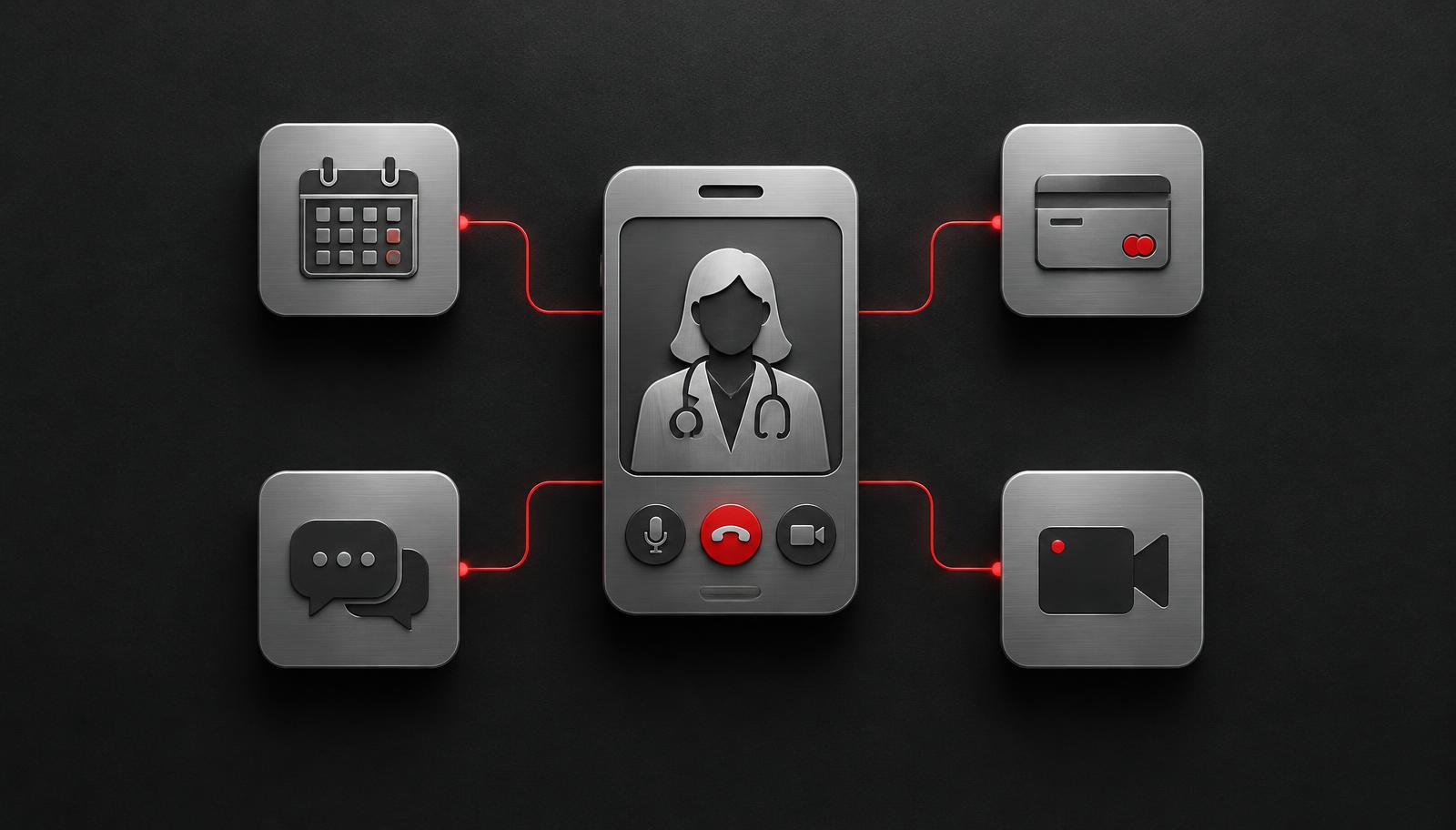
A telemedicine product is usually several connected experiences, not simply a patient-facing application with a video button. Clinicians need reliable context and documentation. Operations teams need tools to resolve scheduling problems without unrestricted access to clinical records. Patients need a clear path when technology or care delivery fails.
| Component | What it includes | Why it moves the budget |
|---|---|---|
| Patient app | Registration, intake, booking, visits, messages | Platforms, accessibility, and recovery paths multiply testing |
| Clinician workspace | Queue, schedule, notes, follow-ups | Clinical workflow and permissions require discovery |
| Video | Calls, device selection, reconnects, quality monitoring | Infrastructure choice and network conditions affect effort |
| Scheduling | Availability, time zones, cancellations, reminders | Concurrency and exception handling complicate logic |
| Payments | Card collection, copays, refunds, reconciliation | Payment processing and insurance are different systems |
| EHR integration | Patient matching, appointments, clinical documents | External access and write-back behavior need validation |
| Administration | Onboarding, support, reporting, access management | Often absent from early feature lists |
Estimate these components separately, then include the work connecting them. A booking screen may be straightforward; keeping its appointment state consistent with payment, notifications, clinician availability, and an external EHR is not. Integration testing belongs in the estimate rather than an unspecified contingency.
Define the care model before estimating features
Start with who delivers care, to whom, and under what operational rules. Scheduled behavioral health, on-demand urgent care, and specialist follow-up may all use video, but they need different queues, intake forms, escalation paths, and documentation. A platform serving an existing practice differs from a marketplace recruiting independent clinicians.
Identify the initial geography, patient age groups, specialties, visit duration rules, and payment model. Have qualified advisers assess licensing, consent, prescribing, and reimbursement obligations for the intended service. Do not assume that software can determine clinical or legal eligibility from a mailing address alone. Patient location during the encounter may matter operationally and legally.
Translate those decisions into explicit boundaries. For example, a release might support scheduled adult follow-ups for one practice, without controlled-substance prescribing, insurance claims, or emergency services. Those exclusions make estimates more meaningful and help the care team explain what patients should do when the service cannot meet their needs.
MVP versus a full virtual care platform
An MVP should be the smallest safe, usable care journey, not the smallest collection of attractive screens. Patients must be able to book or enter a visit, complete necessary intake, join the clinician, understand the outcome, and obtain help. Staff must be able to support that journey without improvised access to sensitive databases.
A focused MVP might use a responsive patient website, a browser-based clinician workspace, one appointment type, a managed video service, and a limited administrative console. It might defer native applications, complex insurance workflows, group care, and multiple EHR connections. Deferring a capability is reasonable only if the resulting clinical operation remains workable.
A full platform commonly adds mobile applications, multiple organizations, specialty-specific forms, longitudinal messaging, integrated prescribing, insurance workflows, richer analytics, and enterprise administration. Each addition can affect existing permissions and data structures. Multi-organization isolation, for example, should be considered architecturally even when only one organization participates in the pilot.
Write release acceptance criteria around completed outcomes: a patient can recover from a dropped call; a clinician can finalize documentation; a support agent can investigate an appointment without reading the clinical note. This prevents an MVP label from hiding unfinished operational work.
Feature-by-feature scope decisions
Registration, identity, and intake
Account creation includes account recovery, duplicate records, consent capture, and the distinction between an account holder and a patient. Dependent profiles, guardianship, and proxy access require additional rules. Decide whether identity proofing is necessary and which organization owns exceptions when verification fails.
Intake forms need more than text fields. Branching questions, required answers, version history, clinician review, accessibility, and retained consent evidence all affect effort. If administrators can change forms, estimate a controlled publishing workflow rather than assuming developers will edit every questionnaire forever.
Scheduling and matching
Scheduling must reconcile clinician availability, appointment length, buffers, time zones, cancellations, and rescheduling. Concurrent booking attempts need a defined outcome. Daylight saving changes and patients traveling between time zones deserve explicit tests rather than assumptions about device settings.
On-demand matching introduces queue priorities, clinician presence, wait estimates, and abandonment handling. Specify who intervenes when no clinician is available. A queue interface without staffing policies and exception tools can transfer engineering savings into expensive manual operations.
Messaging and follow-up
Asynchronous messaging introduces unread states, attachments, response expectations, and routing when a clinician is unavailable. Clarify whether messages become part of the medical record and how they are retained. Do not present secure messaging as a substitute for emergency communication.
Follow-up may include visit summaries, referrals, instructions, and notifications. Keep sensitive details out of notification previews. Decide whether an email merely tells the patient to sign in or contains information that needs a different privacy assessment and delivery process.
Clinician and administrative tools
Clinicians need clear patient context, encounter status, draft notes, finalization, and correction workflows. Autosave must not make an unfinished note appear signed. If several staff members can edit the same encounter, conflict handling and attribution become part of the scope.
Administrative staff need search, scheduling corrections, refunds, and account support. Build permissions around actual job responsibilities. A single all-powerful administrator role may simplify a demonstration but creates avoidable privacy and operational risk in production.
Video options: WebRTC and managed providers
WebRTC supplies browser and application capabilities for real-time media, but it is not a complete telemedicine infrastructure service. A team building around it must still address signaling, connectivity, relay services, monitoring, device compatibility, and operational support. Network restrictions can require traffic to traverse relay infrastructure, affecting both reliability and ongoing expense.
A managed video provider can supply SDKs, media infrastructure, and operational tooling. That can reduce infrastructure work, but the team still owns appointment authorization, session creation, waiting rooms, participant permissions, and failure handling. Evaluate supported platforms, accessibility features, regional availability, contractual terms, and the specific services covered by any required business associate agreement.
Compare providers using realistic scenarios: a patient switches from Wi-Fi to cellular, a browser loses microphone permission, an interpreter joins late, or a clinician reconnects after a laptop sleeps. Test representative older devices and constrained networks. A successful call between two developers is not sufficient acceptance evidence.
Group visits, screen sharing, live captions, and recordings each expand scope. Recording is not a default requirement for telemedicine; it introduces consent, retention, access, and storage questions. Keep it out unless the clinical and operational need justifies that additional work.
Ask for separate estimates for the video integration and its recurring consumption. Model session duration, participants, concurrency, relay traffic, recording if applicable, and support commitments. Confirm how the application behaves during provider outages and who communicates alternatives to patients.
Native versus cross-platform development
Native iOS and Android applications provide platform-specific control but require separate implementation and release work. Cross-platform frameworks can share substantial interface and business logic, yet device permissions, video SDKs, push notifications, accessibility behavior, and store submissions still need platform-specific attention.
A responsive web release may be the most economical first step when the core journey works well in supported browsers. It avoids some installation friction and can simplify updates. However, mobile browser media behavior and background limitations may not meet every service's requirements. Validate those constraints before selecting web solely to reduce initial effort.
Choose through a short technical exercise using the actual video and identity dependencies. Compare supported devices, expected release frequency, internal team experience, and the amount of native functionality required. Our mobile app development services and mobile cost guide by app type provide related platform-planning context.
Avoid equating shared code with identical effort across platforms. Accessibility audits, device testing, release approvals, and support documentation remain necessary. Also budget for clinician web tools and the backend: neither disappears when the patient application uses a shared framework.
EHR, prescribing, and insurance integrations
EHR connectivity
An EHR connection can mean reading basic patient data, creating appointments, importing medication lists, or writing encounter documentation. These are distinct capabilities with different permissions and testing needs. Name the target EHR, customer environment, available interface, data direction, and required refresh timing before accepting an integration estimate.
FHIR availability does not guarantee that every required workflow is supported. Patient matching, terminology, document formats, authorization, pagination, and rate limits still matter. Legacy interfaces may be necessary for particular transactions. Our HL7 vs FHIR guide explains the distinction, while EHR integration services address implementation planning.
Include access procurement, sandbox limitations, mapping reviews, reconciliation, retry handling, and production validation. Assign ownership for conflicting records. A successful API response does not prove that a clinician can find the correct document in the receiving system or that a failed update will reach the right support team.
E-prescribing
Prescribing is not just a pharmacy search field. Scope may include prescriber enrollment, medication selection, pharmacy routing, status updates, and medication history access. Controlled-substance workflows can introduce additional identity, authentication, auditing, and regulatory considerations. Confirm current requirements with qualified advisers and the selected prescribing partner.
Separate application engineering from vendor onboarding and clinical approvals. Determine how clinicians handle failed submissions, duplicate requests, pharmacy changes, and prescriptions started outside the platform. Avoid promises that every prescribing scenario is included in a generic integration line item.
Insurance and payments
Card payments, insurance eligibility, claims submission, and payment reconciliation are separate workflows. An eligibility response does not guarantee reimbursement or establish the final patient balance. Explain those distinctions in product language and in the budget so finance and clinical teams share the same expectations.
For insurance-supported care, specify eligibility checks, benefit interpretation, coding responsibilities, claim corrections, remittance handling, and support ownership. These may involve clearinghouses and existing billing systems rather than custom software alone. Cash-pay can narrow initial scope, but it still needs receipts, refunds, disputes, and reconciliation with appointment outcomes.

Compliance and security work
A telemedicine product operated by or for a covered entity commonly handles protected health information. HIPAA applicability depends on the parties and activities, not simply whether the product uses video. Begin with a data map and a documented assessment of obligations. Consult the HHS Security Rule overview and qualified counsel rather than treating a vendor badge as proof of compliance.
Budget for risk analysis, access controls, authentication, auditability, secure transmission, storage protection, backups, and incident procedures. Evaluate business associate relationships and agreements where required. Confirm that chosen vendor services, configurations, and subprocessors fit the intended data handling. A signed agreement does not secure an incorrectly configured application.
Testing should cover patient-to-patient isolation, clinician access boundaries, privileged accounts, session expiration, recovery procedures, and sensitive information in logs. Security work also includes development practices: reviewing dependencies, protecting secrets, controlling deployments, and limiting production access. Our HIPAA-compliant app development checklist provides a planning companion.
Keep accessibility, privacy, and clinical safety visible alongside security. Test keyboard navigation, screen readers, error messages, and alternatives when video fails. Neither an external penetration test nor a completed checklist replaces the organization's continuing responsibility to operate the service safely.
Team composition and delivery phases
A credible delivery plan identifies product ownership, clinical input, design, application engineering, backend engineering, quality assurance, infrastructure operations, and security expertise. Specialists need not all be full-time, but their responsibilities cannot simply vanish. An integration engineer may be essential even when the user interface is modest.
Discovery establishes patient journeys, clinical boundaries, data flows, technical constraints, and acceptance criteria. Its outputs should include a prioritized backlog, integration assumptions, initial architecture, risks, and an estimate with explicit exclusions. Discovery should reduce uncertainty, not merely produce attractive mockups.
Design and technical validation follow, sometimes overlapping. Test difficult workflows with clinicians and representative patients. Prove high-risk dependencies such as EHR access or video behavior before implementing every screen. Identify unresolved decisions and assign owners so they do not repeatedly interrupt development.
Implementation should deliver complete vertical slices: registration through a completed test visit, for example. Then harden the system through automated tests, realistic workflow testing, security review, accessibility checks, and operational rehearsals. Reserve time to fix findings rather than treating review as the final calendar event.
A pilot validates actual workflows with controlled participation and clear support coverage. Expansion follows evidence, not a launch announcement. Estimate each phase separately and specify what must be true before moving forward. Calendar time also depends on customer decisions, vendor approvals, and clinician availability, not only developer capacity.
Hidden and ongoing costs
Initial build effort is only one part of telemedicine app development cost. Recurring infrastructure, video usage, notifications, identity services, observability, and vendor support can grow differently. Model a normal month, a growth scenario, and a peak-demand scenario using your own expected activity rather than generic traffic assumptions.
Operational work includes account recovery, clinician onboarding, payment exceptions, data corrections, vendor coordination, and incident handling. Some tasks belong to clinical or support staff, not developers. Document that separation so the development budget does not disguise staffing needs elsewhere in the organization.
Maintenance includes operating system changes, browser behavior changes, SDK updates, dependency patches, and app store requirements. External APIs can change or retire supported versions. Maintain representative test accounts and environments so upgrades can be checked without using production patient information unnecessarily.
Backups need restoration tests, and incident plans need rehearsals. Set retention policies with appropriate advisers and account for storage, archival, and deletion implementation. Export and vendor exit capabilities also deserve funding; otherwise a future platform change can become a costly emergency migration.
Reduce cost without weakening the care journey
Reduce breadth before reducing safeguards. One specialty, one organization, one payment model, and a narrow platform launch can lower uncertainty while preserving a coherent patient experience. Defer optional customization, advanced reporting, and complex engagement features until real usage demonstrates their value.
Use established services when their contractual, technical, and operational characteristics fit. Reusing video or payment infrastructure often makes sense; adopting a poorly fitting service can create workaround costs. Run small proofs of concept for expensive dependencies before committing to a long implementation.
Reuse a design system, standardize clinical form patterns, and automate repeatable testing. Keep product decisions timely by assigning an empowered owner and scheduling clinical reviews. Unresolved requirements and repeated changes can consume more budget than the choice between two reasonable frontend frameworks.
Evaluate every proposed shortcut against its later cost. A temporary manual process can be sensible for a low-volume pilot if ownership, privacy controls, capacity, and replacement criteria are documented. Manual work that silently grows with every visit is not a durable cost-reduction strategy.
How to compare quotes
Give bidders the same workflows, launch platforms, integrations, operating assumptions, and acceptance criteria. Ask them to distinguish confirmed requirements from allowances and unknowns. A smaller estimate may omit administrative tooling, security remediation, or external onboarding rather than reflect more efficient delivery.
Request effort by workstream, proposed roles, dependencies, and deliverables. Separate discovery, implementation, testing, launch support, third-party charges, and continuing maintenance. Clarify whether estimates include clinical workflow reviews, accessibility testing, data migration, training, and documentation.
Examine commercial terms as carefully as totals. Who owns source code, infrastructure accounts, app store accounts, and design assets? What triggers a change request? How are delays caused by external vendors handled? What does warranty support cover, and when does paid maintenance begin?
Ask for a walkthrough of the riskiest assumptions. A strong proposal explains how uncertainty will be reduced and how the estimate will change when assumptions fail. Do not demand false precision before the team has access to integration documentation and the people who run care delivery.

RFP checklist for a useful estimate
Provide enough detail that vendors can price the same service rather than imagine different products. Include the following material in the request and ask bidders to mark anything they cannot yet assess.
- Care model, specialties, launch geography, and patient eligibility boundaries.
- User roles, proxy relationships, and organization-level access rules.
- Patient, clinician, administrator, and support workflows with failure paths.
- Launch platforms, supported devices, browsers, languages, and accessibility expectations.
- Video requirements, expected visit patterns, and optional media capabilities.
- Named EHR, prescribing, payment, and insurance dependencies with access status.
- Data categories, retention expectations, migration needs, and export requirements.
- Security responsibilities, required agreements, review activities, and evidence deliverables.
- Acceptance criteria, pilot approach, launch responsibilities, and support coverage.
- Ownership terms, recurring cost assumptions, exclusions, and change-control process.
Also identify who can approve clinical, legal, financial, and product decisions. Ask each vendor to return a responsibility matrix and a dependency register. Those documents reveal whether the schedule assumes work your organization has not yet assigned.
Frequently asked questions
How much does telemedicine app development cost in 2026?
There is no defensible single figure without scope. Platforms, workflows, integrations, security work, and operating expectations determine effort. ELEKTRIK provides scoped estimates after discovery rather than publishing a standard price list. Request a build estimate and an operating-cost model as separate deliverables.
Is a managed video service always cheaper than WebRTC?
Not necessarily. Managed services can reduce infrastructure engineering and operational responsibility, but introduce usage charges and vendor constraints. Building directly around WebRTC adds infrastructure and maintenance work. Compare both approaches against your actual call patterns, reliability requirements, team capabilities, and required contractual protections.
Can we launch without EHR integration?
Sometimes, if the care organization can safely manage documentation and reconciliation through an approved process. Define who performs manual work, how records remain accurate, and when integration becomes necessary. Omitting integration from the first release should not create an undocumented parallel medical record.
Does HIPAA compliance come from the hosting provider?
No. Appropriate hosting and agreements are only part of a larger program. Application behavior, workforce access, risk management, vendor relationships, and operating procedures also matter. The organization must assess its responsibilities and maintain safeguards as the product and care model change.
Should we build native mobile apps immediately?
Only when the patient journey and device requirements justify them. A responsive web pilot may validate service demand and workflows with less initial breadth. Native or cross-platform apps can follow when installation, notifications, device access, or repeated use make them a better fit.
What should happen before requesting a fixed-price proposal?
Resolve major workflows, name integration targets, establish acceptance criteria, and identify external dependencies. If those details remain uncertain, commission a bounded discovery phase first. A fixed price attached to vague requirements usually shifts uncertainty into exclusions, contingency, or later change requests rather than eliminating it.
Plan the service, then price the software
A useful estimate connects every major feature to a care workflow, an accountable owner, and a testable outcome. It also recognizes the difference between building an application and running a dependable clinical service. That distinction is the foundation of an honest telemedicine budget.
ELEKTRIK has built telemedicine products including Doctor On Demand. Explore our telemedicine development services, broader healthcare software development, or related Amgen case study for context, then contact us to discuss a scoped estimate based on your actual requirements.